Showing posts with label Jazz. Show all posts

Sunday, June 6, 2010

Cannonball Adderley – The Cannonball Adderley Quintet in San Francisco

On this 6th day in June, which will for sure be a great day, jazz is always a good fallback. I’ve been to San Francisco only once before and though brief, it was more than enough for me to grasp just how breathtaking it is. The city is a huge area that encompasses city life and huge bodies of water. I remember walking out of their Amoeba location and seeing the mist from the ocean come over us as we walked to grab a slice of pizza from a local shop. For this live recording, Julian “Cannonball” Adderley enlisted his quintet to play at San Francisco’s “The Jazz Workshop” to record over two days, to standing room-only crowds, in October of 1959 and everything is spectacular.

The five songs on here are all felt with Adderley’s rhythmic soloing (you could transpose it and notice all of his accents and think it was the drummer’s part) and his brother’s, Nat Adderley, exceptional trumpet playing. Much more subdued than that of his bigger bro’s, it’s still melodic and soothing the way his cornet comes to life. One of the highlights is a Randy Weston tune, “Hi-Fly,” in 4/4 meter; this was a breakthrough since Weston was primarily known for his waltzes: check out the solos by the two brothers on this one.


But this album sparked what was called the movement of “soul jazz” where everything was pouring straight from the heart. Cannonball makes note of it on opening song, “This Here,” (written by his pianist Bobby Timmons) and it’s prefaced with a small insert before the song that reads A Few Words by Cannonball…and “This Here.” Even at just five songs, it was a monumental album in many regards and continues to hold high prestige even 50 years later. Here is that opener in all its wonderment. – Bryan

Sunday, May 30, 2010

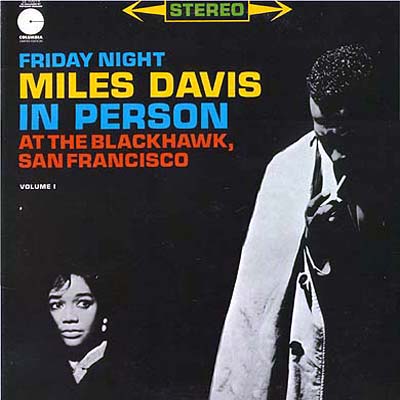
Miles Davis - In Person at the Blackhawk, San Francisco (Friday Night, Volume 1)

If you ever took the time to check out all of Miles Davis’ recordings and looked into how vast it is, you’d be stunned. Wikipedia has it broken down into studio recordings, live recordings, compilations, by record label and so much more and on Allmusic’s site, when you click on either Albums or Compilations, the page takes a good while to load. So it goes without saying that Davis' catalog is deep and still, so much of it is considered essential to this day.

His 1961 performances at the Black Hawk nightclub in San Francisco must have been something special to watch. He performed on a Friday and Saturday on April 21 & 22 with his quintet which consisted of him on trumpet, Hank Mobley on sax, Wynton Kelly on piano, Paul Chambers on bass and Jimmy Cobb on drums – tremendous musicians for sure. Not only was this groundbreaking for a jazz musician to take his combo to a club but the music was a brilliantly rendered thing of beauty. Check out “Bye Bye Blackbird” and its amazing rendition:


The entire set was re-issued on what appears to be an excellent release and recording back in 2003 but sadly, I only own the Friday performance on vinyl. I was fortunate to even find just that first volume because even at just six compositions, you can really sense the unity and cohesiveness in the band. Davis was THE master at surrounding himself with talented musicians that were sometimes, better than him (check out all his stuff with John Coltrane) but in a live setting, he never held back. His rhythm section creates memorable patterns and the type of jazz he was playing at the time (straight ahead and fierce) is truly felt on this live recording. Probably the most important musician in the 20th century, here is another song off the Friday set, “Love, I’ve Found You” – Bryan

Sunday, May 23, 2010

Buddy Rich and Max Roach – Rich versus Roach

When you talk about two of the greatest drummers of all time, getting together to combine their quintets to deliver fierce solos back and forth then you’re talking about something special. Regarded by some as “The world’s greatest drummer,” Buddy Rich proved just that with his ear for melody, his impeccable technique and unmatched style. And though Roach was seven years younger and still coming onto his own, Rich versus Roach finds the both of them stopping at nothing to present an impressive collaborative album.

Back in 1959, the two bands took breaks from their touring schedules to hit the studio for a two-day session of music. Each drummer would lead his band and they would play the same song, with different musicians from each band taking turns at solos. But make no qualms about it, this was the drummers’ album and they showcase that on “Figure Eights” very nicely. At first supposed to be just a brief solo battle, each drummer would rip off alternate eight bar solos back and forth and it made for some magnificent music. Hear it here:


And before that, the two bands would gel into “The Casbah,” a smooth samba-pace that suited the outstanding sax players well. This one features Roach on mallets and he decorates the space with splendid touches; Rich would be on cymbals and each band allows their trumpets to take solos. It’s probably the most laid-back song on the album with Roach leading the four-bar drum breaks and it provides a nice change of pace from the intensity that is on every other song. You can hear it below (both songs have the same title and they are surprisingly the same length, crazy) but in all, it’s an amazing piece of history in that it features two of the best drummers of all time going head to head in a friendly battle of skills and honestly, you can’t go wrong with that – Bryan.

Wednesday, April 28, 2010

Miles Davis – Sketches of Spain


So old music huh?

I’ve always felt that 1959 is still, arguably, the best year for music of all time. And I know that people scoff or laugh at me for even thinking in such a way but when certain years like that come up, they need to be discussed. I mean you had releases by the Dave Brubeck Quartet, Ray Charles, Billie Holiday, Miles Davis, John Coltrane, TWO albums by Charles Mingus and Ornette Coleman. And again, arguably, one could make the case that for each album those respective artists put out, they never released anything better. And when you think of the most ‘famous’ one, Miles Davis, Kind of Blue is most definitely, the most easily loved/regarded/mentioned album of his. And he had the most prolific, the deepest and one of the best discographies of all time.

And for the longest time, I always assumed that Sketches of Spain, one of my favorite albums of his was released in 1959 – that lasted for a good five or so years until someone politely pointed out that it was released in 1960. And with that, there is this masterful album that finds the American jazz composer/trumpeter paired with Gil Evans to collaborate on a jazz album composed and derived from the Spanish music itself. In many ways, it’s his most accessible album in that it strays so far from the standard jazz feel and sense. I mean, a jazz album has to be freely moving and fluid enough to know that half of it was pure improv but Sketches of Spain moves as if two brilliant composers entirely created it themselves. Naturally, this is not a complaint but merely, a point of observation but in other words, you’ll find many that love this album just as much and if not more than the aforementioned Davis album.

Regardless of where it stands in terms of styles of music, it’s gorgeously rendered through the lens of a creative genius that was hitting on all cylinders. The use of an orchestra is immense here with sounds of a tuba, bassoon and string bass all riding high on the album’s opening magic, “Concierto de Aranjuez” (Adagio),” [found below (one piece but split into two)], which was actually borrowed by Davis and Evans from Joaquín Rodrigo. While the second side consists of three exceptional pieces all written by Evans, it is the both of them that present an album that is just as memorable now, as it was fifty years ago.

I loved it when Davis answered, after being questioned on the album’s sounds and if they could even be considered jazz if not another style of music, “It’s music, and I like it.” – Bryan


Tuesday, March 9, 2010

The Souljazz Orchestra – Rising Sun


Label Strut Records has been putting out some consistently amazing music for the past few years. Last year, they really rocked my socks off with their third edition in the Inspiration Information series, an album by the legendary Mulatu Astatke and The Heliocentrics. They’ve got a new Astatke album (his first studio album in over 20 years) coming out at the end of March which will be great but they also have a fantastic new album by The Souljazz Orchestra, out now, entitled Rising Sun.

A largely acoustic album, the sounds on this brilliant release are rooted in African rhythms, gorgeous jazz and varying styles. The musicianship is where it’s at with musicians that easily travel into different modes and keys before always finding their way back home – even when it isn’t exactly to the tonic. And that’s just the thing, even when they’re all over the place, there is still a richly warm tone to their sound and in every sense of the word, this is an exceptional album.

The artwork is astounding as well and the label took to it so much that they decided to make a video inspired by it. Here is that video for the song “Agbara,” off that aforementioned album – Bryan

Season 2, Episode 5: UNWANTED ENDINGS

We have a new episode: the fifth one to our second season available HERE ! I don't know how consistent THIS will be but since I mention ...